

after Margaret prayed for me,
I suddenly thought of a man.
A Navajo.
At that moment,
I didn’t immediately understand
why he came to mind.
Only that his name
lingered in my mind.
When I got home,
I began to search again for stories about the Navajo.
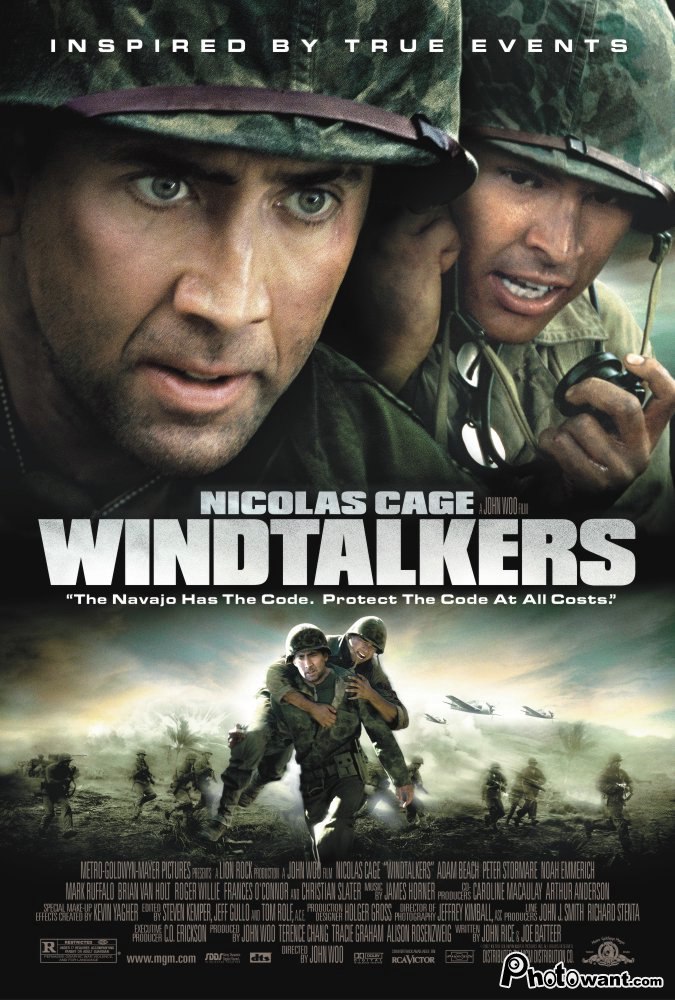
And then I saw Windtalkers, directed by Hong Kong director John Woo.
It is a film set during World War II,
about Navajo code talkers.
It tells how the Navajo Indians built a code system for the U.S. military
that the Japanese could never break.
But what truly shook me
was not the war.
It was this: the Navajo people
had once been oppressed by the U.S. government.
They were forced off their ancestors’ land.
Forced to relocate.
Discriminated against.
Even lived for so long in poverty and on the margins.
Yet when war came,
they were still willing to work for this country.
They even helped the United States
win the Pacific War.
Why would someone who had been hurt
still choose to help
the country that had hurt them?
If it were me,
could I do it?
For the first time, I began to think:
Maybe truly strong people
are not those who have never been hurt.
They are those who, even after being hurt,
still refuse to let hatred
become the center of their lives.
And just then,
I thought of David again.
This time,
I decided to go back and find his story.
David was a Navajo Indian.
Born in 1926 on a reservation in Arizona.
His mother was Navajo.
His father was a white Catholic priest.
Soon after he was born,
his mother left him
to become a nun and a nurse.
So he was raised by people in the tribe.
By eleven, he was already drinking.
In his early teens, he secretly boarded a merchant ship
and was taken all the way to Australia.
On the ship,
he met a German boy.
His name was Ted.
No one knew then —
that years later,
war would bring them together again.
When World War II broke out,
David was drafted.
Because the Navajo language was nearly impossible to crack,
the U.S. military placed Navajos into a secret communication system.
They were responsible for sending military intelligence
from behind enemy lines back to Allied bases.
And those messages — no one could break them.
Later,
David was captured by the Nazis behind enemy lines.
They tortured him.
They nailed his feet to the ground with long spikes.
They forced him to stand for hours.
That is not a metaphor.
That was real torture.
Later,
the Germans decided he had no more value
and prepared to send him to a death camp for execution.
And just in front of the train car,
someone suddenly shoved him with a rifle butt.
Ordering him to move forward.
David looked back —
the German officer
was none other than Ted, the boy he had met on the merchant ship.
Ted secretly saved him.
He transferred him to a prisoner of war camp.
When the war ended,
by the time the U.S. military found David,
he was near death.
He was sent back to America.
He was in a coma for two and a half years.
When he woke up, he could barely walk.
Doctors fitted him with heavy leg braces.
He could only drag himself forward with crutches.
Later,
the military arranged for him to enter a veterans’ hospital,
planning to have him spend the rest of his life there.
But before going,
he decided to return to the Navajo reservation
to say goodbye to his people.
When the tribe saw what he had become,
they fell silent.
Then,
the elders did something unbelievable.
They removed his braces.
Tied ropes around his waist.
And threw him into the raging Colorado River.
They said to him:
“David, call your spirit back.”
“Because of hatred,
your spirit is no longer in you.”
“Without your spirit,
your wounds will not heal.”




)