

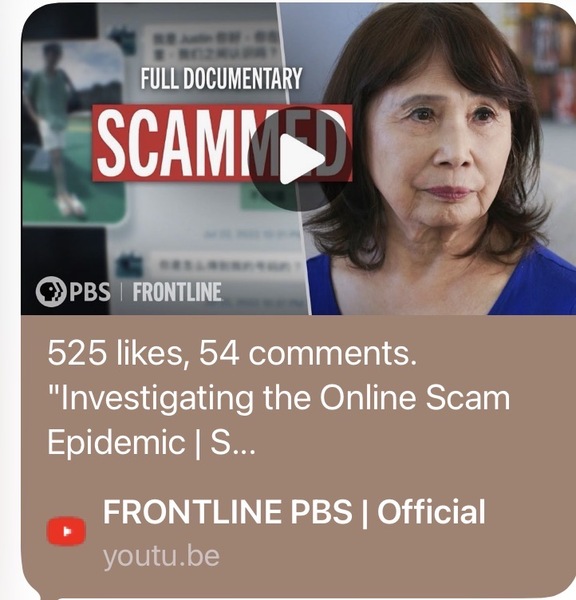
Last night, I finally sat down and watched Scammed, the documentary jointly produced by PBS FRONTLINE and the Associated Press.
I thought I already knew what the documentary was about.
After all, I was one of the victims featured in it.
For more than a year, I had been interviewed, welcomed the film crew into my home, provided materials, and returned again and again to a part of my life I would rather not revisit.
But it was not until last night that I saw the complete story for the first time.
When it was over, I realized that what they had done was far more than tell my story.
They had pulled the camera back.
Far enough that I could finally see what we, the victims, were really facing.
This Is Not Just a Story About Older People
The documentary does not begin with me.
It begins with a seventeen-year-old boy named Gavin Guffey.
His family remembered him as artistic, lively, and someone who brought joy to others.
One night, he encountered someone online who claimed to be a young woman.
Very quickly, what appeared to be an ordinary online conversation turned into sextortion.
After obtaining intimate images of Gavin, the person threatened to send them to people he knew and demanded money.
For a seventeen-year-old, the fear and shame of that moment must have been overwhelming.
That same night, Gavin ended his life.
I watched his father, Brandon, describe that night—how he rushed into the bathroom, held his son in his arms, and felt his life slowly slipping away.
My heart broke.
We often hear about scams targeting older people.
I was in my seventies when I was scammed.
But Scammed showed me that this has never been only a problem affecting older people.
A seventeen-year-old can become a victim.
Highly educated people can become victims.
Doctors, lawyers, and technology professionals can become victims.
Some are deceived through love. Some through investments. Some through fear. Some through shame.
Scammers are not looking for “stupid people.”
They are looking for human nature.
And every one of us is human.
For the First Time, I Truly Saw the “System”
Then the camera left the United States.
It went to Nigeria.
To Myanmar.
To Cambodia.
I saw how scammers create false identities.
I saw how they use scripts.
I saw how someone can believe they are talking to the same person every day, while behind the screen, different people may be taking shifts playing the same role.
I even learned that they have a method called “emotion building”—gradually developing an emotional connection, gathering information about the victim, and then weaving that information back into the conversation so the person begins to feel:
This person understands me.
I froze when I saw that.
Because I remembered something I had said in the documentary:
“Again and again, he was building up my trust.”
What I had personally experienced had a name.
It had scripts.
It had steps.
I once believed that I had been deceived by a man named Justin.
Only gradually did I begin to understand that I may never have been dealing with just one person.
Last night, watching Scammed, the truth that had taken me years to understand gradually appeared in full on the screen.
It was not one person.
It was a system.
And it was an industrialized criminal system.
When the Camera Came Back to Me
About forty minutes into the documentary, the camera returned to the United States.
And then I saw myself.
On the screen, I heard myself say:
“Suddenly, you’ve lost all your life savings. Not only my life savings, also my husband’s life savings.”
Then I heard myself say:
“I felt bad. I felt, you know, a little bit stupid at that time.”
“Why would I do a thing like that?”
Whenever I had asked myself that question before, I always looked for the answer within myself.
Was it because I did not understand cryptocurrency?
Was it because I trusted people too easily?
Was it because I was older?
But last night, when I heard that question coming from the television again, it felt different.
Because before my story appeared, viewers had already watched nearly forty minutes of the documentary.
They had already seen the scam compounds.
They had seen the fabricated identities.
They had seen the scripts.
They had seen how different people could take turns pretending to be the same person who did not actually exist.
They had seen how criminal organizations studied people’s emotions, trust, loneliness, hopes, and fears.
So when I heard myself ask:
“Why would I do a thing like that?”
the answer was no longer simply:
“Alice, why didn’t you see it?”
The real question should be:
How does such a sophisticated, highly organized criminal system lead someone, step by step, into believing the world it has created?
That is also why I have become increasingly uncomfortable with dividing victims into those who are “smart” and those who are “not smart.”
What scammers exploit is not intelligence.
They exploit trust.
And trust is one of the most important things between human beings.
The $18 Million Wallet
Justin told me that he had survived a plane crash, that his wife had died, and that he had nearly lost his own life.
He sent me a photograph of himself lying in a hospital bed.
I felt sympathy for him.
Later, he told me that he was worth more than $100 million and began teaching me how to invest.
In the documentary, I said:
“At that time, I thought I could trust him.”
“I just totally followed what he said, step by step.”
I had said those things before.
But last night, hearing them within the context of the entire documentary, they carried a different weight.
Because now I had seen the system behind that “step by step.”
When my daughter realized something was wrong, we discovered that the world I had believed was real had been false from the beginning.
A false identity.
A false investment platform.
False profits.
A false future.
But the money I sent was real.
Then the documentary revealed something from the tracing of my money that shocked even me.
TRM Labs followed my money through the blockchain.
Eventually, they traced it to a cryptocurrency wallet containing $18 million.
My money was not the only money there.
The wallet also contained money from other victims.
At that moment, I was no longer seeing only the more than $700,000 I had lost.
I saw a river.
Money from many victims flowed in from different places, mixed together, passed through wallet after wallet, moved and concealed, eventually flowing toward criminal organizations.
Ari Redbord of TRM Labs said in the documentary that my case was actually a fairly standard case.
If someone had told me several years ago that what happened to me was “standard,” I might have been deeply hurt.
But last night, I understood what he meant.
It did not mean that my pain was unimportant.
It meant that what happened to me was not an isolated experience.
I was not one person who happened to encounter one scammer.
I was one of the people found by a vast criminal system.
“Are You Still Alive?”
Then I heard those words again.
“Are you still alive?”
They were the last words the scammer left me before disappearing.
In the documentary, the reporter asked me:
“What do you think he meant?”
I told her that I thought he knew that after losing so much money, a person might not be able to bear it.
Then, on the screen, I heard myself say something very painful.
At that time, I really had reached a point when I did not want to live.
Sitting in front of the television and hearing myself say those words again, I knew that was Alice four years ago.
She did not yet know what would happen next.
She did not know that she would report the crime.
She did not know that she would go to court.
She did not know that one day she would testify before the California Legislature.
She did not know that she would speak to the media again and again.
And she certainly did not know that one day PBS FRONTLINE and the Associated Press would include her story in a documentary investigating the global scam industry.
On the screen, the reporter was still waiting for my answer.
Then I heard myself say:
“I’m alive and I’m going to fight back.”
Last night, I finally understood that I have been living out the story behind those words for four years.
Another Father Is Fighting Back, Too
But Scammed did not leave the idea of “fighting back” with me alone.
Later in the documentary, I returned to Gavin’s father, Brandon.
After losing his son, he did not stop.
He pushed for legislation.
He took Gavin’s story to Washington.
Again and again, he told his son’s story, hoping that another child would not have to experience what Gavin had experienced.
As I watched him, I felt both sadness and happiness for him.
His loss and mine are completely different.
I lost money.
He lost his son.
A child cannot be brought back.
But I understand why he cannot stop.
When something has already happened to you, and you know it will continue happening to others, sometimes the only thing you can do is carry your pain into the world and see whether it can protect the next person.
Gavin’s father has his path.
I have mine.
He took his son’s story to Washington.
I took my story to the California Legislature.
We do not know each other.
And we did not experience the same kind of scam.
But last night, as I watched him, I kept thinking:
I know why you keep going.
Because I am still going, too.
When the Camera Pulled Back Even Farther
But the camera in Scammed did not stop with us.
It kept asking:
What allows such an enormous criminal system to operate?
Who provides the internet?
Who provides the servers?
Who provides the social media platforms?
Who provides the financial channels?
When these legitimate technology and financial systems are exploited by criminal organizations, how much do companies know? And how much can they do?
This was one of the parts that affected me most deeply.
FRONTLINE and the Associated Press investigated how scam compounds connect to the internet, including the use of Starlink satellite internet.
They investigated the technology infrastructure.
They questioned Meta.
They questioned Starlink.
They questioned internet and server companies.
They also questioned law enforcement and government agencies.
The companies named in the investigation also gave their responses, explaining how they address abuse, cooperate with law enforcement, and deal with technical and legal limitations.
Not every question has an answer.
But to me, something very important happened:
These questions were finally being asked publicly.
If scams have become a global industry, we cannot continue asking only the victims:
“Why did you believe them?”
“Why did you send the money?”
“Why didn’t you discover it sooner?”
We also need to ask:
How can such an enormous criminal industry so easily find us, approach us, gain our trust, take our money, and then move that money away?
That does not mean that any one technology company or financial institution should be held responsible for every scam.
It means that when the methods of crime change, the ways we protect people must change too.
I Hope It Creates Ripples
After watching the documentary, one word kept coming to mind:
Ripples.
A small stone falls into the water.
At first, there is only one small circle.
Then another.
And another.
Slowly, they spread outward.
I hope Scammed will be like that.
Perhaps a parent will watch it and begin talking with a child about online sextortion.
Perhaps a young person who sees Gavin’s story and receives a threat will no longer carry the shame alone, but will immediately turn to family or someone they trust for help.
Perhaps someone developing an online relationship will suddenly recognize the familiar steps.
Perhaps someone preparing to move money into cryptocurrency will stop and ask one more question.
Perhaps more victims will realize that they are not the only ones.
Then the ripples continue outward.
To the banks.
To social media companies.
To technology companies.
To the cryptocurrency industry.
To law enforcement.
And finally, to government.
I do not know whether these changes will happen, or how long they will take.
But I know one thing:
When the public begins to see the system, it becomes harder to leave all the responsibility with the victims.
If the Money Is Found, What Comes Next?
There was another part of the documentary that I could not stop thinking about.
The government has already seized large amounts of assets connected to scam operations.
That is important.
But as a victim, I naturally think of the next question:
Can the money that is recovered eventually be returned to the victims?
I know this is not a simple question.
One criminal wallet may contain money from many different people.
Victims may live in different states and different countries.
There are legal procedures, evidence, questions of ownership, and the challenge of proving which funds came from which victim.
But difficulty should not become a reason to stop looking for an answer.
If blockchain technology allows investigators to trace the movement of money;
if governments can locate and seize criminal proceeds;
then I hope the next question will be taken just as seriously:
How can we build a better system to return, whenever possible, money that can be identified as belonging to victims?
For someone who has already lost everything, this is not an abstract policy question.
It may be their retirement.
Their home.
Their children’s education.
It may even be their chance to stand up again.
Thank You for Pulling the Camera Back So Far
So this article is also my public thank-you letter to the PBS FRONTLINE and Associated Press team.
Megan, Martha, Peter, David, Oscar, and everyone who worked on Scammed:
Thank you.
Thank you for not simply coming into my home, filming my tears, and leaving.
Thank you for not turning this into a story about “how Alice lost more than $700,000.”
You went to find Gavin’s family.
You found other victims.
You found scammers.
You found people who had themselves been deceived and trafficked into scam compounds.
You followed the scripts.
You followed the money.
You followed the cryptocurrency wallets.
You followed the technology infrastructure.
And you asked those who have the power to change things:
What can you do?
Thank you not only for telling my story.
Thank you for pulling the camera back so far that even I, a person living inside the story, could finally see the larger picture.
One documentary cannot solve the global scam crisis.
But it can do something very important.
It can help people see.
And when enough people begin to see, perhaps the ripples begin.
After the Documentary Ended
The documentary was over.
But my mind was still with the people whose stories I had just watched.
I thought about Gavin.
Seventeen years old.
A life gone.
I thought again about his father.
He cannot bring his son back.
But he can carry Gavin’s name forward.
Then I thought about myself four years ago.
At that time, I did not know what “fight back” would mean.
I only knew that I could not fall down.
Later, I reported the crime.
I organized the evidence.
My brother and I organized and translated more than eight hundred pages of conversations into English.
I went to court.
I went to the California Legislature.
Again and again, I reopened the wounds I least wanted to touch.
Not because I enjoy telling the story of how I was scammed again and again.
But because if my story can help the next person recognize those steps one day earlier, perhaps that person will not have to go where I went.
Last night, when I heard myself say again on television:
“I’m alive and I’m going to fight back.”
I suddenly realized:
These four years have been my answer.
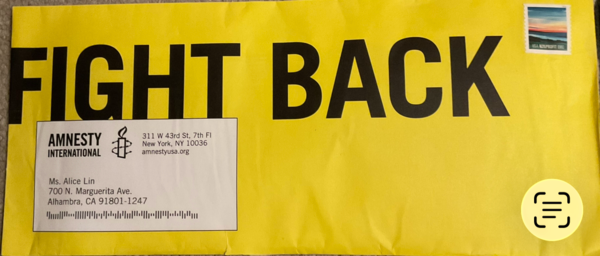
Then, after the documentary ended, I saw a large yellow envelope.
It was from Amnesty International.
Across the envelope were two enormous black words:
FIGHT BACK.
I looked at it.
And I smiled.
Only a short time earlier, I had heard my four-years-younger self say on television:
“I’m alive and I’m going to fight back.”
Now the documentary was over.
And those two words were in front of me again.
I do not need to explain it.
I only know that when I saw them, something inside me was very clear:
I did it.
And I will continue.
Near the end of the documentary, we hear that what is happening today has become a global attack on human trust.
I think that is also what I felt most deeply after watching all of Scammed.
This has never been only a problem affecting older people.
It is not only about cryptocurrency.
And it is certainly not only about asking why one victim “believed.”
It is about whether we can still trust a photograph.
Trust a voice.
Trust the person on the other side of a screen.
Trust the platforms we use every day.
Even trust our own judgment.
That is why victims cannot fight this alone.
Technology companies, financial institutions, law enforcement, governments, and every one of us who uses the internet are part of this story.
One documentary cannot end this battle.
But it can help more people see.
Seeing can lead to understanding.
Understanding may lead to anger.
And anger may lead to change.
Those are the ripples I hope Scammed will create.
One circle.
Then another.
Continuing outward.
Four years ago, someone asked me:
“Are you still alive?”
Today, my answer is still the same:
Yes, I’m still alive.
I fought back.
And I will continue.
I will not stop.