

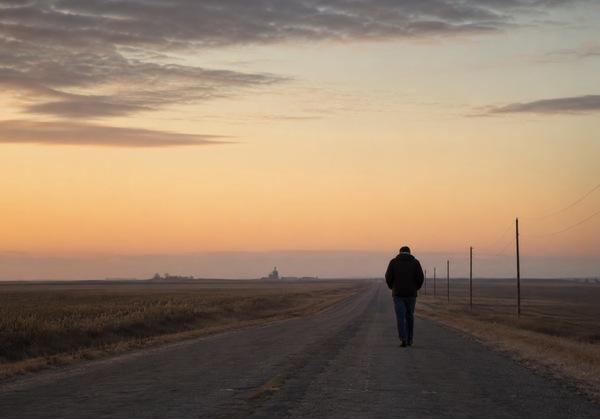
In a small town like Elkhart, Kansas,
a bank is not just a bank.
It is a farmer’s harvest for the year.
An elderly person’s life savings for retirement.
The trust shared among people in a church community.
And the way an entire town continues believing in one another.
In places like that,
people know each other.
They worship together.
Watch high school football games together.
Spend entire lifetimes side by side.
And Shan Hanes
was one of the people everyone trusted.
He was not an ordinary banker.
He was the president of Heartland Tri-State Bank.
He had served as chairman of the state bankers association.
He had even testified before Congress on behalf of community banks.
He understood finance.
He understood risk.
He understood banking systems.
If there were someone in this world
who should have been least likely to fall for a scam—
most people would have assumed
it was someone like him.
But later, I came to understand something:
The most terrifying thing about pig-butchering scams
is not that they deceive people who “know nothing.”
It is that, step by step,
they lead people into a state
they cannot walk out of.
—
At the beginning,
the story was actually very ordinary.
Messages on a phone.
Investments.
Cryptocurrency.
Profits that appeared to grow larger and larger.
At first,
only a few thousand dollars.
Then the numbers on the screen began to rise.
Tens of thousands.
Hundreds of thousands.
Millions.
And hope rose with them.
—
But the cruelest part
was the fake website.
Hanes watched his “investment”
grow to more than two hundred million dollars.
That detail is extremely important.
Because this was not blind impulse.
He had “evidence.”
He could see the numbers himself.
See the account still there.
See the profits increasing.
See the wealth on the screen growing larger and larger.
The number was fake.
But to him,
it was real.
And that also explains
why he could not stop.
Because in his world,
the money had not disappeared.
It was only “locked.”
So every time
he tried to withdraw the money,
they would tell him:
Just one more step.
One more transfer, and the funds would unlock.
—
When I reached this part,
I felt something deeply.
Because I knew that by then,
he was no longer investing.
He was chasing.
Chasing the money already lost.
Chasing the promises made by the system.
Chasing the sentence:
“Just one more step,
and everything will come back.”
—
It resembled gambling.
But in some ways,
it was even more frightening than gambling.
Because gamblers know they are gambling.
But people trapped inside pig-butchering scams
often believe they are simply
trying to recover what already belongs to them.
—
So he kept putting in more.
At first,
his own money.
Then friends’ money.
Then:
church funds,
investment club funds,
his daughter’s college fund—
and eventually,
even the bank’s own money.
—
Later, people would remember only the enormous number:
Forty-seven million dollars.
But I have always felt
that the truly frightening thing
was not the number itself.
It was knowing
he was not trying to destroy the town.
He simply could no longer stop.
—
There is one scene in the documentary
I will never forget.
Early in the morning,
he went to a friend asking to borrow twelve million dollars.
He said:
Just ten days.
In ten days, I can get the money back.
His friend looked at him
and kept saying:
“You’re being scammed.”
But even at that moment,
he still believed:
One more step,
and everything would come back.
—
At that moment,
I felt no blame.
Only a deep sadness.
Because I suddenly understood:
What traps people in the end
is often no longer the scammer.
It is this thought:
“If I stop now,
then everything I lost before
will truly be gone.”
—
Later, the FBI recovered part of the money
from Tether cryptocurrency accounts in the Cayman Islands.
That was almost a miracle.
Because in most cryptocurrency scams,
once the money is transferred out,
it is nearly impossible to recover.
The funds move too quickly.
The accounts become too fragmented.
Cross-border tracing is extraordinarily difficult.
But this time—
some of the money
was recovered.
—
November 4, 2024.
Inside the courtroom,
people began to cry.
Thirty shareholders learned
that their money would be almost entirely returned.
One woman
had believed she would recover only one thousand dollars.
Instead, she received nearly two hundred fifty thousand dollars—
her retirement savings
had come back.
—
When I read that part,
I felt something very deeply.
Because endings like this
are extremely rare.
Most victims
never live to see that day.
And even more heartbreaking is this:
even when the money comes back,
some things
never do.
—
What that town lost
was not only money.
It was:
the trust that once existed
between people.
—
A society cannot stand without trust.
And perhaps the saddest truth of all is this:
the people most vulnerable to being hurt
are often the very ones
still willing
to believe in others.


)