


LA TIMES: ‘My life cannot be ruined by this scammer.’
The turning point didn’t begin in front of a camera.
It started with a press conference.
My attorney held a public briefing about the responsibility of financial institutions in fraud cases. I was one of the victims he represented. Another woman in Northern California had lost more than $1.8 million in the same type of pig-butchering scam.
After the briefing, the phone started ringing.
First, it was local media.
Then, national outlets started calling.
In total, more than thirty reports were published, denoting a shift from privacy to publicity.
As news coverage grew, my private pain began shifting into something more public.
It became a public record—evidence that could educate and protect others.
—
One question reporters asked me again and again was:
“You’re highly educated. How could you fall for a scam like this?”
One reporter from the Los Angeles Times rubbed his forehead during the interview and told me that many victims he had spoken with were university professors, professionals, engineers—people with very high levels of education.
“Why does this happen?” he asked.
At first, my answer was simple.
Maybe people who spend a long time in academic environments are trained to think logically, but we’re never taught how to recognize mental manipulation.
We believe in systems.
We believe logic will eventually win.
We still believe that people are fundamentally good.
But when what you encounter is a system specifically designed to manipulate trust—
Those very assumptions can become your weakness.
Over time—after months of research, reflection, and conversations with others—my initial uncertainty gradually gave way to clarity.
It’s not about intelligence or education.
It isn’t about education.
It isn’t even about greed.
It’s about confronting a system engineered to exploit trust.
Once you’re connected to that system, it isolates you, encourages you, pressures you, and seduces you. It always moves faster than your doubts. Unless you cut it off immediately and completely, most people find it extremely difficult to escape.
This is a structural trap, not a personal failure.


CBS/KCAL- TV News
- Reporters also asked another question:
“Why don’t victims want to speak out?”
Because shame often becomes the second wall after the scam itself.
First, the money disappears.
Then your sense of dignity collapses.
People say things like:
“How could you believe that?”
“Were you being greedy?”
“How could you be so careless?”
Those words hurt more than the financial loss itself.
But in that sense, I counted myself very fortunate, because my support system was unique.
When my family learned what had happened, not one of them asked me, “Mom, how would you let this happen?”
Not one.
My eldest daughter immediately mobilized the entire family.
They organized the documents.
They contacted law enforcement.
They reached out to federal agencies.
They made sure the case entered the proper legal process.
There was no blame.
Only action.
I didn’t even have time to sink into shame.
Some people might call it greed.
They might say I was greedy.
But what I wanted wasn’t luxury.
I have a son who requires special care. I wish to make sure he will be secure in the future and won’t become a burden on his siblings.
If that kind of hope is called greed—
Then I accept that.
But it’s not greed.
It’s protection.
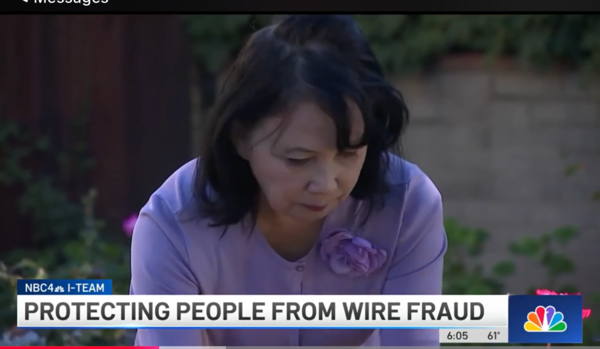
KNBC-TV
One reporter asked me quietly:
“You still have a long life ahead of you. Without that money, what will you do?”
I answered very calmly.
“When God closes a door, He opens a window.”
What happened cannot be undone.
But I can choose how I see it.
If the money cannot be fully recovered, let it serve as a warning.
If the loss cannot be reversed, let it serve as a signal to others.
If even one elderly person reads the story and stops before transferring money—
If one family is saved from being torn apart—
If one victim finds the courage to speak up—
Then none of this will have been in vain.

In the end, this isn’t just my story.
Many people have been harmed in the same way, but they may never have the chance to speak out. I happen to have an education, the ability to communicate, and the responsibility to let this story move beyond my own life.
For me, appearing in the media was never about publicity.
It was about putting the truth on record.
Scams survive when stories stay hidden.
But once something enters the public record, it can no longer be quietly erased.
When a story is written, broadcast, and archived, it no longer belongs only to one person.
It becomes a piece of verified history.
A quiet but powerful form of evidence.
And evidence, eventually, moves society forward.




)