

An AP/FRONTLINE Investigation Made Me See the World After Fraud Differently
Author’s Note
On September 2, 2026, The Associated Press (AP) and PBS FRONTLINE published a joint investigation based on interviews with 58 fraud victims in the United States. The investigation examined what is going wrong in the way America currently protects and assists people after they have been scammed.
I was one of those interviewed.
This article is not a complete Chinese translation of the AP report. It is my response after reading it—as a victim, and also as someone who is still telling her story.
The portions describing the AP/FRONTLINE investigation are my Chinese summary and rendering of the reporting. Where the report discusses my own case, I have also presented that material in Chinese so Chinese readers can understand how AP told my story. The reflections written in my own voice come from my personal experiences and feelings. I have tried to keep the two distinct and to represent the original reporting as faithfully as possible.
After the article was published, I received many responses.
Some people asked me why, after so many years, I continue to tell my story publicly, again and again.
This article is also my answer to that question.
—Alice Lin
⸻
On September 2, 2026, The Associated Press and PBS FRONTLINE published a joint investigation:
Scams in the US Are at a Record High. Yet Most Victims Get No Help and Some End Up Losing Even More.
The report did not focus only on the question:
Why does someone get scammed?
It asked another question:
What happens afterward?
The money is gone.
The victim finally knows the truth.
But what happens next?
Who do you turn to?
The bank?
The police?
The FBI?
A government agency?
An attorney?
And if the money cannot be recovered, what else must the victim face?
Debt?
Taxes?
Shame?
Family members who do not understand?
Perhaps even another scam, this one promising to “help you recover your money”?
AP/FRONTLINE interviewed 58 fraud victims in the United States, ranging in age from 32 to 90. They came from different racial, income, educational, and professional backgrounds, including doctors, information technology professionals, and academics.
Their losses ranged from thousands of dollars to $4 million.
But the 58 people shared some common experiences.
They had felt alone and confused.
Many felt that at the moment they most needed help, they did not know where to turn.
Some had thought about suicide.
Two had attempted it.
Some of the victims in the report encountered another group of people after the first scam was over—people who claimed they could help recover the money they had lost.
They were scammed again.
For the first time, through 58 different lives, I saw the wounds fraud leaves behind.
Losing the money is not always the end of the story.
Sometimes, it is only the beginning of another kind of suffering.
The report also compared the way the United States currently prevents fraud and protects victims with approaches being taken in countries including the United Kingdom, Australia, and Singapore.
Some countries have begun requiring banks, telecommunications companies, or digital platforms to take greater responsibility for preventing scams. Others are trying to provide more direct assistance after victims discover they have been defrauded.
These systems differ, and all of them are still evolving.
But together they raise an important question:
When fraud has become this large and this complex, can we continue placing all the responsibility on the person who ultimately presses the “transfer” button?
Then, among those 58 stories, I saw my own name.
⸻
How AP Told My Story
Under current U.S. law, financial institutions generally bear little responsibility for transactions authorized by customers themselves.
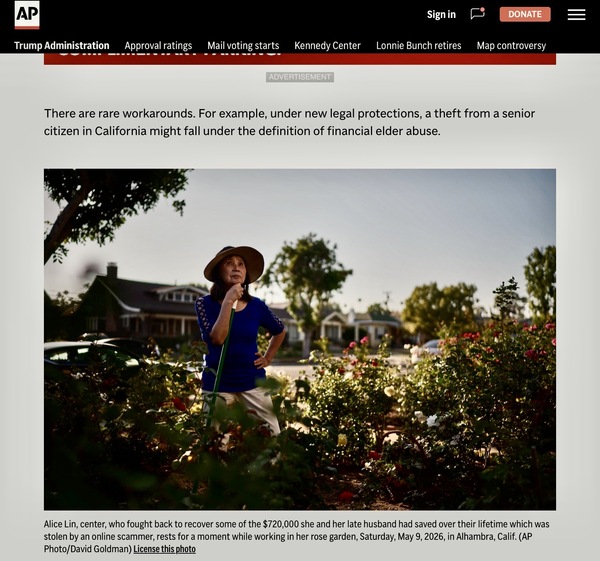
There are, however, limited exceptions. In California, for example, under legal protections for older adults, the taking of an older person’s property may constitute financial elder abuse.
Among the victims interviewed by AP/FRONTLINE, Alice Lin was the only one who recovered part of her losses. She sued her bank under this law.
Alice and her late husband, Ming, had worked hard for many years and accumulated more than $700,000 in savings together.
After her husband died, she met a man online. She believed they had developed a friendship, and the man told her that he, too, had lost his spouse.
Her new friend, Justin, persuaded her to withdraw money from her bank and invest it through cryptocurrency platforms.
At first, her account appeared to show substantial profits.
But when Justin encouraged her to borrow money from her daughter and invest even more, her family discovered that it was a scam.
Alice sued her bank, arguing that it had failed to protect an older customer and failed to raise sufficient warnings about unusually large and atypical transfers.
According to AP, her attorney said the lawsuit was later settled for an undisclosed amount.
The bank said it had multiple layers of fraud protection, including bank employees who had questioned Alice about the transactions and provided written warnings. In a written statement, the bank said the settlement was a business decision made after weighing the cost of the litigation.
In one photograph published by AP, I am sitting on the sofa in my California home, with a wire-transfer document in the foreground.
In another, I am standing in my rose garden.
That was the life I had rebuilt, little by little, after losing my life savings.
But what the investigation revealed next suddenly took my story from more than $700,000 to a scale I had never imagined.
According to blockchain analysis conducted by TRM Labs for AP/FRONTLINE, I had not simply been targeted by a lone scammer. I had been targeted by a complex criminal network.
The network operated dozens of different scams.
Between January 2022 and September 2024, it received at least:
$800 million.
Ari Redbord, global head of policy at TRM Labs, said the industrialization of fraud has made it increasingly difficult for victims to recover their money.
The report then described how the grief and shame of losing my savings had once led me to think about ending my life.
But after I had already stopped responding, the person who scammed me sent one more message.
Just one sentence:
“Are you still alive?”
During the AP interview, the reporters showed me those words again.
Even after all these years, my body trembled.
I told them:
“I told myself: I’m still alive. I’m going to fight back.”
⸻
My Reflection — 58 People
When I first saw the number in the AP/FRONTLINE report—
58 victims—
I stopped.
I was surprised.
During the time AP and FRONTLINE were interviewing me, I had asked how many victims they had interviewed and how many were actually willing to come forward publicly.
I remembered hearing that they had contacted and interviewed more than 80 people, but that not many were willing to speak publicly.
So when I later saw the number 58 in the published report, I was not only surprised.
Part of me was glad.
More people were willing to come forward.
I understand very well why some people are not.
No one wants to admit that they were scammed.
Even less do they want to be asked:
“How could you be so stupid?”
“It was so obvious. How could you not see it?”
“Were you just greedy?”
For someone who has already lost everything, those words can become a second injury.
I was very fortunate.
My family never blamed me.
When my children learned what had happened, no one scolded me.
No one asked:
“Mom, how could you be so stupid?”
They did not keep looking backward and asking:
“Why did you do that?”
“Why didn’t you realize sooner?”
What they did was very simple.
They looked forward.
What do we do now?
What is the next step?
Then the next.
And the next.
I had thought about suicide.
Those were very dark days.
But I was fortunate in another way.
I am a Christian.
When I was in the deepest pain and confusion, when I no longer knew what to do, I still had people who could pray with me.
My family held me up.
My faith held me up too.
So today, when I read about the experiences of other victims in the AP report, I understand something more clearly:
During those darkest days, I was never truly alone.
But not every victim is as fortunate as I was.
Some do not have the support of their families.
Some are afraid to tell their children.
Some have no friend they can call.
Some do not know where to turn for help.
And for some, language itself may make it difficult even to explain clearly to a bank, the police, an attorney, or the media:
What happened to me?
I was educated in the United States.
English is not my first language, but I can speak it.
I can still tell other people what happened to me.
So how could I remain silent?
⸻
Why Do I Keep Telling My Story?
What I lost was my life savings.
It was not money that had suddenly fallen into my hands.
It was money my husband and I had accumulated little by little through many years of hard work.
I know the pain of losing it.
I know the pain of being betrayed by someone I once trusted.
And I know what it feels like to have walked into hell and not know whether you will ever find your way out.
So if I have found my way out, how can I not try to help those who are still inside?
That is why I am willing to tell my fraud story publicly.
Not because I enjoy returning to that pain again and again.
But because someone else is still walking into it.
Perhaps today, someone has just received the first message.
Perhaps it says only:
“Hello.”
Perhaps they have only begun talking.
Perhaps that person has not yet sent the first dollar.
There is still time.
⸻
Why Did I Stay After I Knew I Had Been Scammed?
The AP report also tells the story of another victim, Brian Glick.
He lost $575,000.
After discovering the fraud, he preserved extensive records, reported what had happened to different agencies, and continued communicating with the scammers in hopes of obtaining more information.
When I read that, I did not find it strange.
What surprised me instead was this:
Why didn’t more people do the same?
After I discovered that I had been scammed, I remained in contact with the person who had deceived me for another 39 days.
I did not give him any more money.
My family already knew.
The case had already been reported.
But he did not know that I knew the truth.
So I stayed.
I wanted to keep watching.
I wanted to know what he would do next.
What he would say next.
What methods he would use next.
In the end, I preserved more than 900 pages of chat records.
Looking back now, I increasingly believe that those conversations preserved more than evidence that one person had been “scammed.”
They preserved a process.
The first contact.
Conversation.
Building trust.
The “teacher.”
The first profit.
The next opportunity.
The next target.
The next transfer.
One step.
Then another.
Then another.
Until someone who had never intended to go there had traveled very far.
That is why I keep asking:
How do they find us?
How do they obtain information about us?
How do they know what to say?
And how, step by step, do they bring someone to the point of willingly handing over their own money?
Perhaps because so few people remain and observe the entire process after discovering the truth, there is still much we need to understand about exactly how these scams unfold, one step at a time.
I cannot change the road I already traveled.
But if we can map that road, perhaps the next person, when reaching one of those same steps, will suddenly recognize it:
Am I walking down the same road?
And stop.
⸻
I Was Saving Myself, Too
Over these past several years, I have told my story again and again.
In the California Legislature.
In the media.
In front of cameras.
Sometimes I ask myself:
Why keep telling it?
It already happened.
Telling it one more time cannot make 2022 disappear.
Only gradually did I begin to understand that I kept standing up and speaking not because I thought I could change my own story.
My story cannot be changed.
But perhaps I can change the next person’s story.
If my experience can help someone stop one step sooner;
if a family, after hearing my story, discovers that a parent, husband, wife, or child has been scammed, and their first words are not:
“How could you be so stupid?”
but instead:
“It’s okay. Let’s figure out the next step.”
then what I went through will no longer be only pain.
At first, I thought I was speaking out to help other people.
But after walking this road for so many years, I discovered something I had never expected.
Every time I tell my story,
every time someone tells me that my story made them pay closer attention to fraud,
every time I try to keep another person from walking into the place where I once walked,
I move forward a little too.
I thought I was trying to help other people.
But in helping them, I was also helping myself.
Today, when I look again at that number in the AP/FRONTLINE report—
58.
It is no longer merely a statistic to me.
It is 58 people.
58 families.
58 different lives.
They showed me:
I was not the only one who had been scammed.
And when I look back at my own family, my friends, and the faith that remained with me through my darkest days, I can finally see something else:
I was never alone in my pain, either.
Perhaps that is why we tell our stories.
When one victim speaks, someone else can know:
I am not the only one.
When more of us are willing to speak, what we leave behind is no longer only a collection of victims’ stories.
We leave behind a warning.
Experience.
And perhaps a road map that can help the next person stop in time.
Because right now, someone may have just received that first message.
They have not yet sent the first dollar.
There is still time.